Summary
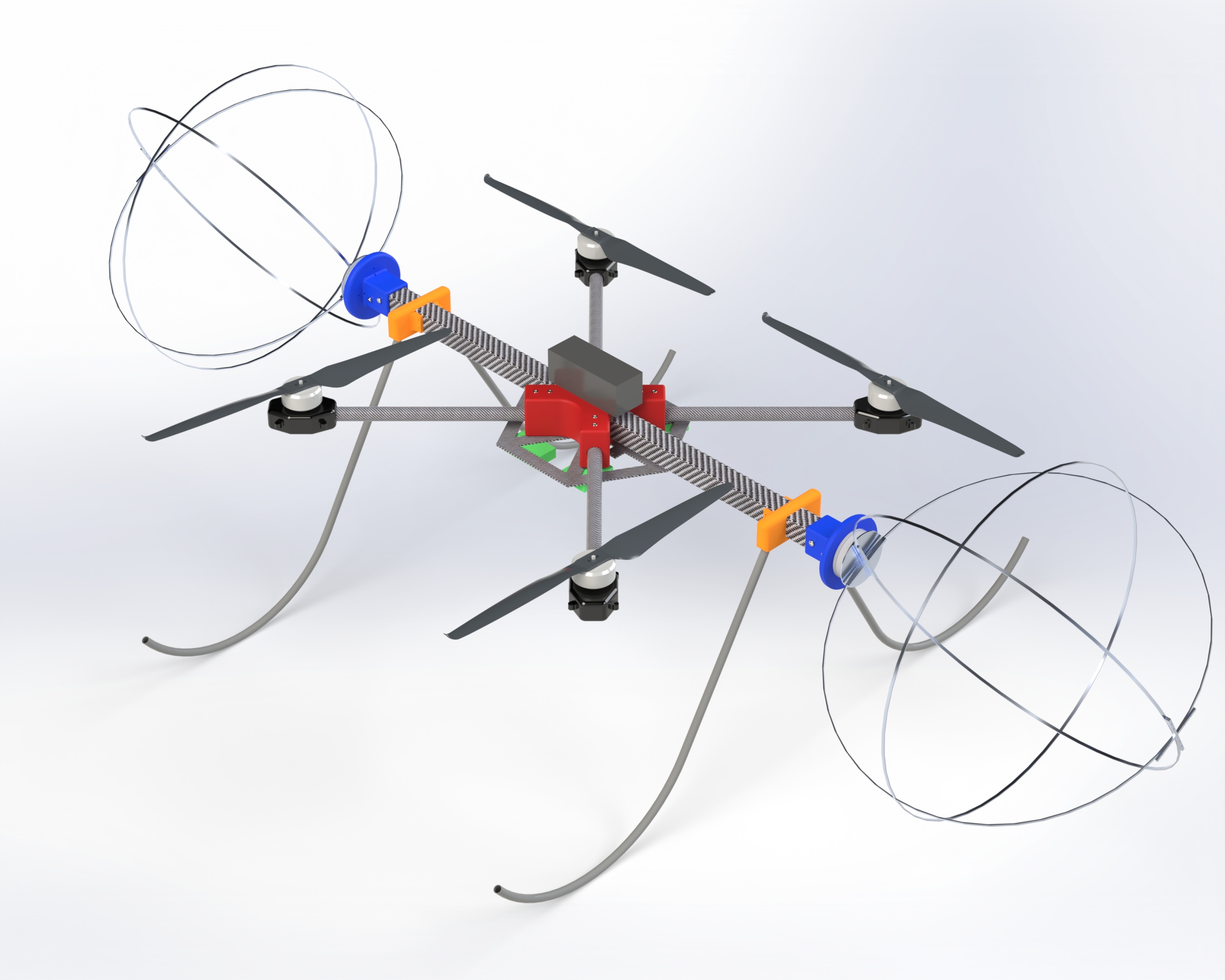
This project began in the spring of 2025 when Professor Mason Peck and I began investigating whether or not an ultralight aircraft could be held in the air using only lift generated by the Magnus Effect via a spinning sphere. Our goal was to develop a human sized ultralight VTOL capable of flying long distances using only the Magnus Effect. To begin this work, I began developing a scaled down quadcopter with spinning spheres on each end with the goal of validating the Magnus Effect as a viable way to keep a craft such as this in the air. During the spring semester, I worked on the design of this vehicle, meeting with Professor Peck weekly and conducting two design reviews for the team.
The following summer, I led a small team of students to actually build and test the Magnus Effect-powered quadcopter I had developed. Through several rounds of iterative testing, the design grew and evolved. Refining the quadcopter was more troubling than expected, and it took several iterations of improvement to the design to enable it to carry a payload of 4 kilograms during flight. Beyond the drone itself, the mechanism for actuating the spheres went through several iterations. After modeling the sphere using ANSYS Fluent and doing research on the drag caused by spinning objects, I determined that we needed to design a geared mechanism to make sure enough torque was produced to spin the spheres in flight. I designed a gearbox-driven hub for the spheres to be attached to. It showed in tests that it was able to generate enough torque.
During this school year, I am continuing to work on this project with my team. We are targeting early this fall to conduct test flights of the full system.

